Best Free AI Tools in 2026 (Tested by Category)
On this page
About 97% of people who use AI never pay a cent for it, according to a 2025 Menlo Ventures and Morning Consult survey. That is not because they are missing out. Free AI tools in 2026 are more capable than the paid products were a year ago. ChatGPT alone reached 900 million weekly active users in early 2026 (TechCrunch, 2026), almost all on the free tier. The hard part is no longer finding a free tool — it is knowing which one wins for each job. This guide breaks down the best free AI tools by category, with the real limits on each, so you can build a free stack that actually works.
Key Takeaways
- Roughly 97% of consumer AI users never pay (2025 Menlo Ventures/Morning Consult survey) — the free tiers are genuinely good enough for most work.
- For chat, ChatGPT (900M weekly users) and Google’s Gemini app (900M monthly users) are the free all-rounders; pick by which ecosystem you live in.
- The best free pick is task-specific: Perplexity for research, Google Veo for video, GitHub Copilot for code, ElevenLabs for voice.
- “Free” means limits, not trials — message caps, daily credits, and non-commercial terms are the trade-off, not a countdown.
- Two things to avoid: OpenAI’s Sora (discontinued April 2026) and assuming Adobe Firefly is still free (its free credits were removed in early 2026).
The smartest move in 2026 is not paying for one tool. It is stacking three or four free ones, each best at its own task. Here is how to build that stack.
How we tested and picked
We judged each tool on four things: whether the free tier is permanent (not a trial), how capable it is on that free plan, how generous the limits are, and whether it works without a credit card. We weighted real, day-to-day usefulness over flashy demos. Where a category had a clear all-rounder, we named one “best free pick” and listed the runners-up with their actual limits.
A note from testing: The biggest surprise was how often the “best” tool was not the most famous one. DeepSeek’s unlimited free chat, GitHub Copilot’s free coding tier, and Google’s free Veo access through Flow all punch above their reputation. Fame and free-tier quality are not the same thing.
One honest caveat up front: free-tier limits change constantly. Every number below is current as of mid-2026, but companies tune these monthly. Treat the limits as a snapshot, and check the official pricing page before you commit to a workflow.
What are the best free AI chatbots?
The best free AI chatbot for most people is ChatGPT, which reached 900 million weekly active users in early 2026 and gives free users access to a GPT-5-class model (TechCrunch, 2026). It is the most versatile all-rounder: writing, analysis, images, voice, and web search in one place.
But the chatbot race is unusually close, and the right pick depends on where you already work.
- ChatGPT (best free pick). Free access to the latest model on a rolling window (you get a set number of advanced messages, then a lighter model takes over), plus image generation, voice, and web search. The widest feature set on a free plan.
- Google Gemini. The Gemini app passed 900 million monthly active users in 2026 (Google, 2026). Free image generation is included, and it shines if you live in Gmail, Docs, and Android.
- Claude. The cleanest writer and reasoner of the group. The free tier runs a Sonnet-class model with roughly 40 short messages on a rolling five-hour window, plus projects and file uploads.
- DeepSeek. The dark horse: genuinely unlimited free chat with a strong reasoning model and no ads. Hard to beat on raw volume.
- Microsoft Copilot. A free GPT-class assistant with image creation, woven into Windows and Edge.
For a deeper head-to-head on which assistant wins for which task, see our comparison of the best AI tools in 2026.
Our read: Do not pick one chatbot and marry it. The free tiers are generous enough that running two is free and smart. We default to ChatGPT for general work and Gemini for anything tied to Google, with Claude open for long-form writing. The cost of that three-tool stack is zero.
What is the best free AI search and research tool?
The best free AI research tool is Perplexity, which answers questions with live web sources and citations attached. Free users get unlimited basic searches plus around five “Pro” deep searches per day, which is plenty for most research sessions. It is built for the job traditional search is getting worse at: a sourced answer instead of ten blue links.
The category is crowded with strong free options, though. Google’s AI Mode and AI Overviews now reach over 2 billion users a month and answer conversational questions directly in Search (Google, 2026). ChatGPT’s built-in search covers the same ground inside a chat. The interesting shift is that searches themselves are changing shape — the average AI Mode query is now three times longer than a traditional one, as people type whole tasks instead of keywords. We break down how to prompt for that in our guide to longer AI Mode searches.
If you want to weigh up the trade-off of getting answers without clicking through to sites, our piece on zero-click search covers what it means for both searchers and publishers.
What is the best free AI image generator?
The best free AI image generators in 2026 are Google’s Gemini app and Microsoft Designer, both of which produce high-quality images at no cost with no credit card. Gemini bundles image generation into its free chat; Microsoft Designer offers unlimited standard generations plus a daily batch of priority ones, watermark-free.
Beyond those two, a few specialists are worth a free account:
- Leonardo AI. Around 150 tokens a day, enough for roughly 15 to 35 images, with strong style control. A favorite for game and concept art.
- Ideogram. The best at rendering legible text inside images — logos, posters, signage — on a limited number of free generations.
- Bing Image Creator. Free DALL-E-class generations, a simple way to get quick images with no setup.
One important correction for 2026: Adobe Firefly is no longer free. Adobe removed its free generative credits in early 2026, so Firefly now requires a paid Creative Cloud or Firefly plan. Plenty of older “best free” lists still get this wrong.
What is the best free AI video generator?
The best free AI video generator is Google Veo, accessed through Google’s Flow tool, which gives free users 50 credits per day plus a one-time bonus. At roughly 20 credits per clip, that is a few short videos a day — enough to learn the craft without paying. Veo’s quality is near the top of the field.
Before anything else, one essential update: OpenAI’s Sora was discontinued in April 2026 (OpenAI, 2026). Do not waste time looking for it. The live free options are:
- Google Veo via Flow (best free pick). 50 credits a day, strong realism and motion.
- Runway. Around 125 one-time free credits for its Gen-4 model, plus a full suite of editing tools.
- Kling. A daily allotment of 66 credits, with watermarked output.
- Luma Dream Machine. A free tier for short image-to-video clips.
Free video tiers are the most limited of any category, and most watermark their output, so treat them as a sandbox rather than a production line. For a fuller walkthrough of the tools and workflows, see our guide to AI video generation.
What are the best free AI writing and productivity tools?
The best free AI writing tool is Grammarly, which fixes grammar, spelling, and tone everywhere you type and includes around 100 generative AI prompts a month on its free plan. It is the rare AI tool that works invisibly in the background of every app you already use.
For the wider productivity stack, these free tiers carry real weight:
- QuillBot. Paraphrasing and rewriting up to 125 words at a time, with no daily cap. A staple for students and editors.
- Canva Magic Studio. Around 500 AI image generations a month, plus AI writing and design tools, inside Canva’s free editor. Canva ranks among the top consumer AI apps by usage (a16z, 2026).
- Gamma. AI-generated presentations and documents from a prompt, on a small batch of free credits.
- Notion AI. A limited number of free AI responses inside Notion’s workspace, useful if you already organize your life there.
What is the best free AI coding assistant?
The best free AI coding assistant is GitHub Copilot, which now has a permanent free tier offering about 2,000 code completions and 50 chat requests a month. For most hobbyist and student workflows, that is enough to feel the productivity boost without paying. Copilot is built directly into the editors developers already use.
The competition here got dramatically better in 2026:
- GitHub Copilot Free (best free pick). ~2,000 completions and 50 chats a month, in VS Code and more.
- Cursor. Its free “Hobby” plan offers around 2,000 completions and 50 slow premium requests a month, no card required. Cursor ranks among the top AI apps by web traffic (a16z, 2026).
- Windsurf. A free tier with unlimited inline completions and a handful of agentic sessions a day.
- Gemini CLI / Code Assist. Google’s free coding tier with generous quotas, handy if you are already in the Google ecosystem.
Our read: Coding is the category where free tiers improved the most this year. A free GitHub Copilot or Cursor account in 2026 does what a paid seat did in 2025. If you have not tried AI-assisted coding because of the price, that excuse is gone.
What are the best free AI audio, music, and voice tools?
The best free AI voice tool is ElevenLabs, whose free plan includes 10,000 credits a month, roughly ten minutes of natural text-to-speech across dozens of languages. The voice quality is the benchmark the rest of the field is measured against. The free tier requires attribution and bars commercial use, but for personal projects it is excellent.
For making sound rather than just speech, the free options split by purpose:
- Suno (music). About 50 credits a day, roughly ten songs, on a non-commercial free plan. The easiest way to generate full tracks from a text prompt.
- Udio (music). Around 100 credits a month with a 10-a-day cap, producing a few full songs daily.
- NotebookLM (audio + research). Google’s research tool turns your documents into an AI “audio overview” podcast, with three a day on the free tier, plus 50 sources per notebook.
- Whisper (transcription). OpenAI’s open-source speech-to-text model is free to run yourself, with no usage cap beyond your own hardware.
What are the best free AI meeting and note-taking tools?
The best free AI meeting assistant is Otter.ai, which transcribes and summarizes meetings in real time, with 300 transcription minutes a month and a 30-minute cap per meeting on its free plan. It joins your calls, writes the notes, and surfaces action items, which is most of what a paid notetaker does.
The main free alternative is Fireflies, which offers 800 minutes of storage per user and a small batch of AI summary credits. Both connect to Zoom, Google Meet, and Teams. If your meetings routinely run past half an hour, watch Otter’s per-meeting cap and lean on Fireflies’ larger storage instead.
How to choose your free AI stack
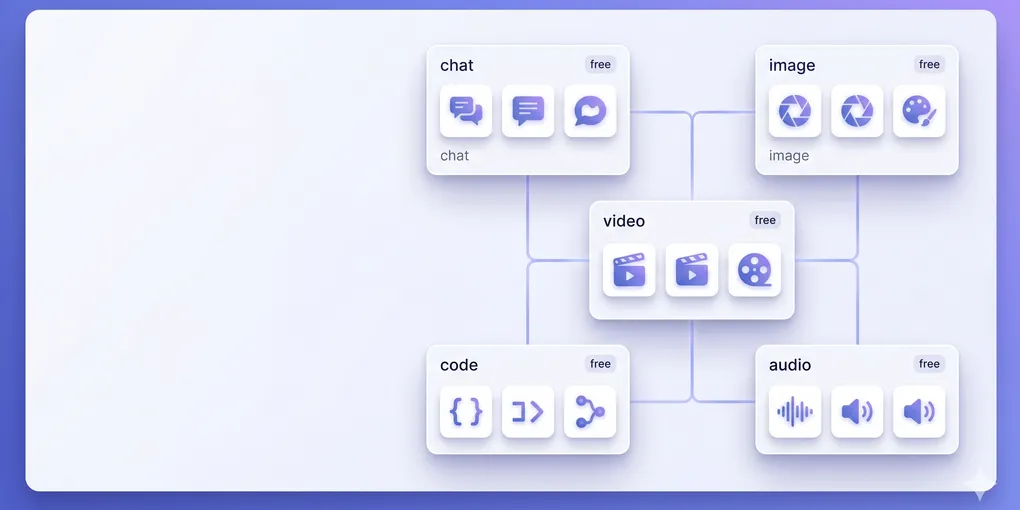
The takeaway from testing dozens of tools is simple: do not search for one tool that does everything. Pick the best free option for each job you actually have. A typical free stack looks like this:
- General chat and writing: ChatGPT or Gemini
- Research with sources: Perplexity
- Images: Gemini or Microsoft Designer
- Video: Google Veo via Flow
- Code: GitHub Copilot or Cursor
- Voice and music: ElevenLabs and Suno
- Meetings: Otter.ai
Every tool on that list is free. The whole stack costs nothing and outperforms any single paid subscription, because no one product leads every category.
Our read: The real “price” of free AI is rarely money — it is attention to limits and terms. Free tiers reset on rolling windows, cap your best requests, and often forbid commercial use. The people who get the most from free AI are the ones who know exactly where each limit sits, and switch tools before they hit a wall. Treat the limits as a map, not a fence.
The bottom line
Free AI tools in 2026 are not a consolation prize. With 97% of users never paying and tools like ChatGPT and Gemini each serving close to a billion people, the free tier is where most of the world actually does its AI work. The capability is real; the only constraints are limits and licenses, both of which you can plan around.
Build a stack, not a subscription. Pick one best-in-class free tool per task, learn its limits, and keep a backup open for when you hit them. Do that, and you will get more out of AI than most people paying for it — without spending anything. If you are still deciding which assistant to anchor your stack with, start with our 2026 AI tool comparison, then layer the specialists on top.
Frequently Asked Questions
What is the best free AI tool in 2026?
For most people it is ChatGPT, which reached 900 million weekly active users in early 2026 and gives free users a GPT-5-class model with limits (TechCrunch, 2026). But “best” depends on the job: Perplexity wins for research, Google Veo for video, GitHub Copilot for code. The right answer is usually a small stack of free tools.
Are free AI tools actually good, or just trials?
Most are genuinely free, not trials. ChatGPT, Gemini, Claude, Perplexity, DeepSeek, Canva, and GitHub Copilot all run permanent free tiers. The catch is limits — message caps, daily credits, or non-commercial use — not a countdown. Roughly 97% of consumer AI users never pay, per a 2025 Menlo Ventures and Morning Consult survey, because the free tiers are enough.
Is ChatGPT or Gemini better on the free plan?
Both are excellent and free. ChatGPT hit 900M weekly users and is the most versatile all-rounder. Google’s Gemini app passed 900M monthly users (Google, 2026) and has the edge if you live in Gmail, Docs, and Android, plus free image generation. Many people use both.
What is the best free AI video generator in 2026?
Google Veo, accessed free through Google’s Flow tool, which gives 50 credits a day. Note that OpenAI’s Sora was discontinued in April 2026 (OpenAI, 2026), so it is no longer an option. Runway, Kling, and Luma also offer free credits. Free video tiers are limited and usually watermarked.
Can I use free AI tools for commercial work?
Sometimes, but check each tool’s terms. Many free tiers, including ElevenLabs, Suno, and Udio, restrict output to personal or non-commercial use, or require attribution. Chatbots like ChatGPT and Gemini generally let you use the text you generate. When money is involved, read the license — the rules differ sharply by tool.
Sources
- TechCrunch, “ChatGPT reaches 900M weekly active users,” retrieved 2026-06-22, https://techcrunch.com/2026/02/27/chatgpt-reaches-900m-weekly-active-users/
- Google, “Sundar Pichai at I/O 2026 (Gemini app 900M MAU, AI Overviews 2B+),” retrieved 2026-06-22, https://blog.google/innovation-and-ai/sundar-pichai-io-2026/
- a16z, “Top 100 Gen AI Consumer Apps, 6th Edition,” retrieved 2026-06-22, https://a16z.com/100-gen-ai-apps-6/
- OpenAI Help Center, “What to know about the Sora discontinuation,” retrieved 2026-06-22, https://help.openai.com/en/articles/20001152-what-to-know-about-the-sora-discontinuation
- Menlo Ventures / Morning Consult, “The State of Consumer AI” (survey of 5,031 US adults, ~3% willing to pay), 2025, retrieved 2026-06-22, https://menlovc.com/perspective/2025-the-state-of-consumer-ai/