Is Perplexity Better Than Google? An Honest 2026 Test
On this page
Perplexity is one of the fastest-growing search tools in the world, and the “is it better than Google?” question is everywhere in 2026. So we ran them side by side. The honest answer is that Perplexity is genuinely better than Google at some things, clearly worse at others, and the gap is narrower than either company’s fans admit — partly because Google has quietly turned itself into an AI answer engine too. This is a hands-on, round-by-round test across the searches people actually do, with the real numbers behind each tool.
Key Takeaways
- Perplexity wins research and multi-step questions. A single sourced answer with inline citations beats ten blue links when you’re trying to understand something.
- Google wins local, navigational, shopping, and breaking-news queries — and its scale is on another planet: over 5 trillion searches a year (Search Engine Land, 2025) versus Perplexity’s ~780 million monthly queries (May 2025).
- The “1 billion monthly queries” claim is not real. Perplexity’s official figure is 780M/month (May 2025); the “1 billion” target was per week. We don’t cite the inflated number.
- Both make mistakes. A 2025 Tow Center study found Perplexity most accurate of eight AI search tools — but still wrong 37% of the time (CJR, 2025).
- The honest verdict: use both. Perplexity to understand a topic, Google to find or buy something. They’re complements, not rivals — yet.
The short answer: better at some jobs, not all
Perplexity is better than Google when your goal is to understand something — to get a synthesized, sourced answer to a real question without clicking through ten tabs. Google is better when your goal is to find or do something — reach a specific site, buy a product, check store hours, or get breaking news. Neither is universally “better,” and the right tool depends entirely on the job in front of you.
That framing matters because the two products are no longer the same kind of thing. Classic Google returns a ranked list of links. Perplexity returns one answer with citations. The twist for 2026 is that Google now does both: its AI Overviews and AI Mode increasingly behave like Perplexity, sitting on top of the familiar blue links. So the real contest isn’t “links versus answers” anymore — it’s “whose answers are better.”
Our read: The most useful way to think about this isn’t “which one wins” but “which one do I reach for first.” After weeks of running both, our habit settled into a clean split: Perplexity for any question that starts with why, how, or compare, and Google for any search that ends in a click — a website, a store, a checkout. You stop asking which is better once you notice you’re already using both for different reasons.
A note on the numbers — and the honesty test
Before the head-to-head, one correction, because this post is supposed to be honest. A very common 2026 claim is that Perplexity crossed 1 billion monthly queries in the first quarter of the year. We could not verify it, and Perplexity’s own disclosures contradict it.
The last official figure the company has given is 780 million queries in May 2025, stated by CEO Aravind Srinivas at the Bloomberg Tech Summit, growing more than 20% month over month (TechCrunch, 2025). In the same breath, Srinivas set a target of 1 billion queries per week within a year — per week, not per month. Somewhere in the retelling, “a billion a week (target)” became “a billion a month (fact).” The 1.2–1.5 billion monthly numbers you’ll see on aggregator sites are third-party estimates, not company data.
That distinction is the whole point of testing search tools carefully. The instinct to repeat a clean, round number without checking the source is exactly the instinct AI search can exploit — or correct. So we’ll use the verifiable figure (780M monthly, May 2025) and the verifiable trajectory: roughly 3,000 queries on Perplexity’s first day in 2022, about 230 million by mid-2024, and 780 million by May 2025.
How we tested
We ran the same set of real queries through both tools and scored each on four things: answer quality (is it correct and complete?), sourcing (can I verify it?), speed to a usable result, and effort (how much clicking and reading did it take?). We used Perplexity’s free and Pro search, and Google’s standard results plus AI Mode and AI Overviews. The queries fell into five everyday buckets: deep research, quick facts, shopping, local, and breaking news.
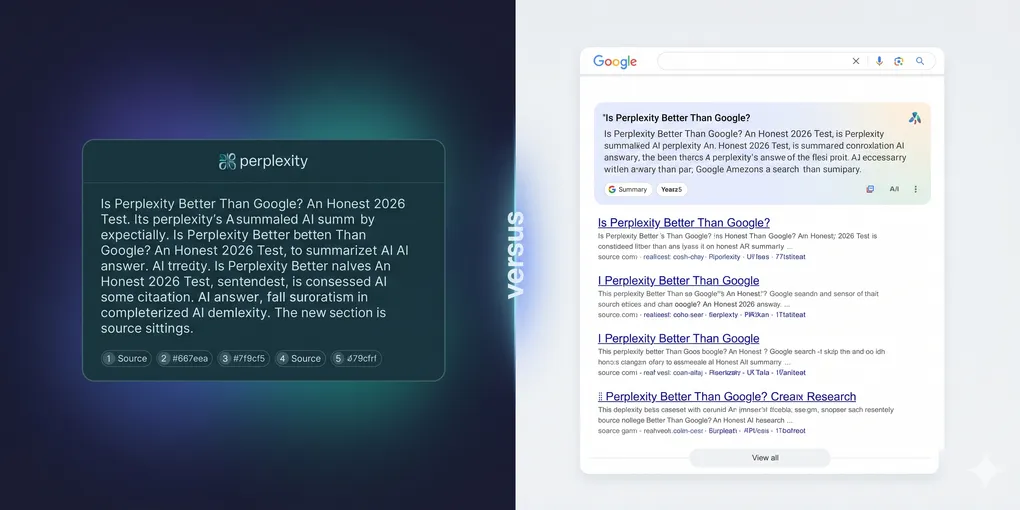
A note from testing: The screenshots in this piece are illustrative mockups of the side-by-side layouts, not pixel captures, because both interfaces change weekly and live captures would be stale by the time you read this. The behavior we describe — who answered better and why — is what we actually observed running the queries in June 2026.
Round 1: Deep research — Perplexity wins
This is Perplexity’s home turf, and it shows. Ask something genuinely researchy — “compare the total cost of ownership of a heat pump versus a gas furnace for a cold-climate home” — and Perplexity returns a structured answer with the trade-offs laid out and a numbered list of sources you can click to verify each claim. Google’s AI Mode now does something similar, and it’s improved enormously, but Perplexity’s answers tend to be tighter and its sourcing is front-and-center rather than tucked behind a “show more” expander.
Perplexity’s Pro search and Deep Research mode push this further, running multiple searches and reasoning across sources before answering. For a question that would normally cost you fifteen minutes and eight tabs, this is the single biggest reason people switch.
Winner: Perplexity. When the job is to understand a topic, a sourced synthesis beats a list of links — and beats Google’s AI Overview on sourcing clarity.
Round 2: Quick facts — a tie that favors Google’s speed
For a simple fact — “how tall is the Eiffel Tower,” “what time zone is Tokyo” — both tools answer instantly and correctly. Google has a slight edge here purely on reflex and speed: its knowledge panels and featured snippets have been doing this for a decade, and the result is on screen before Perplexity finishes composing a sentence. Perplexity’s answer is arguably nicer to read, but for a one-line fact, “nicer” doesn’t beat “instant.”
Winner: Google (narrowly), on speed and muscle memory.
Round 3: Shopping — Google wins, for now
Shopping is where Google’s ecosystem advantage is hard to beat. Google Shopping pulls live prices, availability, reviews, and “buy” links from millions of merchants, with filters and price tracking built in. Perplexity has added shopping features and product cards, and they’re genuinely useful for researching a category (“best robot vacuums for pet hair under $400”) — but when you’re ready to compare prices and actually buy, Google still funnels you to checkout faster.
This is also where Google’s business model quietly reasserts itself. Search and Other ad revenue grew 19% in Q1 2026, with Pichai noting users are “coming back to Search more” (Search Engine Journal, 2026). Commercial queries are Google’s heartland, and it isn’t ceding them.
Winner: Google for transactions; Perplexity is the better pre-purchase research tool.
Round 4: Local and navigational — Google wins decisively
“Coffee near me,” “directions to the airport,” “is the hardware store open now” — these are not contests. Google Maps, real-time business hours, and the sheer density of local data make Google the obvious tool. Perplexity can answer local questions, but it leans on the same underlying web data without Maps’ live, structured layer. If your search ends in a place rather than an idea, use Google.
Winner: Google, decisively.
Round 5: Breaking news — Google wins on recency, both stumble on accuracy
For news that broke in the last hour, Google’s freshness and its Top Stories carousel win on raw recency. But this round comes with the biggest caveat in the whole test, and it cuts against both tools.
A 2025 Columbia Journalism Review (Tow Center) study tested eight AI search engines on sourcing news articles and found they gave incorrect answers to more than 60% of queries. Perplexity was the best of the group — and still got 37% wrong. Grok-3 was worst at 94% (CJR, 2025). The study also found a counterintuitive twist: premium, paid versions sometimes gave more confidently incorrect answers than free ones, because they were more reluctant to say “I don’t know.”
The practical upside for Perplexity: because it shows sources inline, you can catch its errors by clicking through. A confident, unsourced AI summary — Perplexity’s or Google’s — is more dangerous precisely because there’s nothing to check. The lesson isn’t “Perplexity is unreliable.” It’s “verify the citations on anything that matters, from either tool.”
Winner: Google on recency; both lose on unverified accuracy, so click the sources.
Perplexity vs Google: the scoreboard
Five rounds, and the split is clear. Perplexity owns deep research. Google owns quick facts, shopping, local, and breaking-news recency. That’s not a knockout for either side — it’s a map of when to use which.
| Round | Winner | Why |
|---|---|---|
| Deep research | Perplexity | Sourced synthesis beats a link list |
| Quick facts | Faster reflex, instant snippets | |
| Shopping | Live prices and checkout funnel | |
| Local / navigational | Maps and live business data | |
| Breaking news | Freshness; both need source-checking |
If you’re choosing one assistant to anchor everything, our broader comparison of the best AI tools in 2026 puts Perplexity in context against ChatGPT, Gemini, and Claude — and our guide to the best free AI tools covers how far each free tier actually goes.
What Perplexity actually is in 2026
Part of what makes the comparison confusing is that Perplexity isn’t really “a search engine” in the Google sense. It’s an answer engine layered on top of multiple AI models. It runs its own models — Sonar (built on Llama) and R1 1776 — alongside external heavyweights like GPT-5, Claude 4, and Gemini, letting you pick the brain behind your answer.
The bigger 2026 story is Comet, Perplexity’s AI browser. It launched in July 2025 locked behind the $200/month Max plan, then dropped the paywall on March 18, 2026, going free across iOS, Android, Windows, and Mac (MacRumors, 2026). Comet builds agentic search, page summarization, and shopping directly into the browser — which is a direct shot at Google’s most valuable real estate. Perplexity reportedly even offered $34.5 billion to buy Chrome outright in 2025 (TechCrunch, 2025). If you want the bigger picture on agentic browsers, see our piece on Chrome’s auto-browse era.
All of this is funded by serious money: Perplexity raised $200 million at a $20 billion valuation in September 2025, just two months after a round at $18 billion (TechCrunch, 2025).
What Google became in 2026
The flip side: Google didn’t sit still. It rebuilt Search around AI, and the adoption numbers are staggering. AI Overviews — the AI summaries atop results — reached 2.5 billion monthly users, and AI Mode, the conversational Perplexity-style interface, passed 1 billion monthly users in roughly a year, with the Gemini app at 900 million (Google, 2026).
Put those next to Perplexity’s 780 million queries a month and the scale gap is obvious. Google handles over 5 trillion searches a year (Search Engine Land, 2025). Perplexity is a fast-growing challenger; Google is an ocean that has learned to answer like a challenger.
The cost of better answers: the citation fight
There’s an uncomfortable subplot to the “answer engine” model that affects both tools but has hit Perplexity hardest. When a search tool answers your question directly, you often don’t click through to the site that did the original reporting — and that breaks the web’s economics. In 2026, 68% of Google searches end without a click to the open web (SparkToro, 2026). We unpack what that means for searchers and publishers in our zero-click search guide.
Perplexity, built entirely on this model, has drawn lawsuits and accusations from a long list of publishers: the New York Times sued it in December 2025, alleging verbatim reproduction and hallucinated quotes falsely attributed to the paper (TechCrunch, 2025), joining disputes with News Corp, Nikkei, Forbes, Wired, and the BBC (Fortune, 2025). This isn’t a reason not to use Perplexity, but it’s part of an honest picture: the tool that gives you the cleanest answer is also the one most accused of taking too much from the sources behind it.
Our read: The “Perplexity vs Google” framing misses what’s actually happening. The real shift isn’t one engine beating another — it’s that the answer itself is becoming the product, and the open web that feeds it is getting squeezed from both sides at once. Whichever tool you prefer, the skill that matters in 2026 is the same: treat every AI answer as a confident first draft, and click at least one source before you act on it.
The honest verdict
Is Perplexity better than Google? For research and understanding, yes — convincingly. For shopping, local, navigation, and breaking news, no — Google’s data moat and speed still win. On accuracy, neither is safe to trust blindly, but Perplexity’s visible citations make it easier to verify, which is a real advantage in practice.
The most honest recommendation we can give after testing both is unglamorous: use both, on purpose. Reach for Perplexity when your question starts with why, how, or which is better — when you want a sourced explanation. Reach for Google when your search ends in a click — a website, a store, a map pin, a purchase. The people getting the most out of search in 2026 aren’t picking a side. They’re matching the tool to the task, and checking the sources on whatever the answer turns out to be.
If you’re refining how you actually phrase these searches, our guide to longer, task-style AI searches will get better answers out of both tools.
Frequently Asked Questions
Is Perplexity better than Google in 2026?
It depends on the task. Perplexity is better for research and multi-step questions because it returns a single sourced answer with citations instead of ten links. Google is still better for local, navigational, shopping, and time-sensitive queries, and its scale dwarfs Perplexity — over 5 trillion searches a year (Search Engine Land, 2025) versus Perplexity’s roughly 780 million monthly queries (May 2025). For most people the honest answer is “use both.”
Did Perplexity really hit 1 billion monthly queries in 2026?
Not according to Perplexity’s own disclosures. The last official figure is 780 million queries in May 2025 (CEO Aravind Srinivas, Bloomberg Tech Summit). The “1 billion” number was a target of 1 billion queries per week, not per month. The 1.2–1.5 billion monthly figures online are third-party estimates, not company-confirmed data.
Is Perplexity more accurate than Google?
Both make mistakes. A 2025 Tow Center study found AI search engines answered over 60% of news-sourcing queries incorrectly. Perplexity was most accurate of eight tools but still got 37% wrong, while Grok-3 missed 94% (CJR, 2025). Because Perplexity shows sources inline, errors are easier to catch — but you still have to click and check.
Is Perplexity free, and what does it cost?
Perplexity has a permanent free tier with unlimited basic searches plus a few Pro deep searches per day. Pro is $20/month and Max is $200/month. Its Comet browser, launched in 2025 behind the $200 Max plan, became free across iOS, Android, Windows, and Mac in March 2026. Google Search and AI Mode are free.
Will Perplexity replace Google?
Not soon. Google still handles over 5 trillion searches a year, its Search ad revenue grew 19% in Q1 2026, and its own AI answers reach billions — AI Overviews hit 2.5 billion monthly users and AI Mode passed 1 billion by mid-2026 (Google, 2026). Perplexity is reshaping expectations for search, but for most users today it’s a complement to Google, not a replacement.
Sources
- TechCrunch, “Perplexity received 780 million queries last month, CEO says,” retrieved 2026-06-24, https://techcrunch.com/2025/06/05/perplexity-received-780-million-queries-last-month-ceo-says/
- Search Engine Land, “Google: 5 trillion searches per year,” retrieved 2026-06-24, https://searchengineland.com/google-5-trillion-searches-per-year-452928
- Google, “Sundar Pichai at I/O 2026 (AI Overviews 2.5B, AI Mode 1B+, Gemini 900M),” retrieved 2026-06-24, https://blog.google/innovation-and-ai/sundar-pichai-io-2026/
- Search Engine Journal, “Google Search revenue grew 19% in Q1, Pichai cites AI,” retrieved 2026-06-24, https://www.searchenginejournal.com/google-search-revenue-grew-19-in-q1-pichai-cites-ai/573378/
- Columbia Journalism Review (Tow Center), “We compared eight AI search engines. They’re all bad at citing news,” retrieved 2026-06-24, https://www.cjr.org/tow_center/we-compared-eight-ai-search-engines-theyre-all-bad-at-citing-news.php
- SparkToro, “In 2026, less than one-third of Google searches still send a click,” retrieved 2026-06-24, https://sparktoro.com/blog/in-2026-less-than-one-third-of-google-searches-still-send-a-click/
- TechCrunch, “Perplexity reportedly raised $200M at $20B valuation,” retrieved 2026-06-24, https://techcrunch.com/2025/09/10/perplexity-reportedly-raised-200m-at-20b-valuation/
- TechCrunch, “The New York Times is suing Perplexity for copyright infringement,” retrieved 2026-06-24, https://techcrunch.com/2025/12/05/the-new-york-times-is-suing-perplexity-for-copyright-infringement/
- Fortune, “Perplexity lawsuits from publishers (Nikkei, News Corp, and more),” retrieved 2026-06-24, https://fortune.com/2025/08/26/perplexity-lawsuits-publishers-ai-search-nikkei-news-corp/
- MacRumors, “Perplexity’s Comet browser comes to iPhone, free,” retrieved 2026-06-24, https://www.macrumors.com/2026/03/18/perplexity-comet-browser-iphone/